Meet Dominic Bilodeau, Senior Software Developer
Our Senior Software Developer explains how understanding the day-to-day reality of our operations team and of SMB leaders guides the design of our platform and of Lucy, our AI agent.
 Dominic Bilodeau
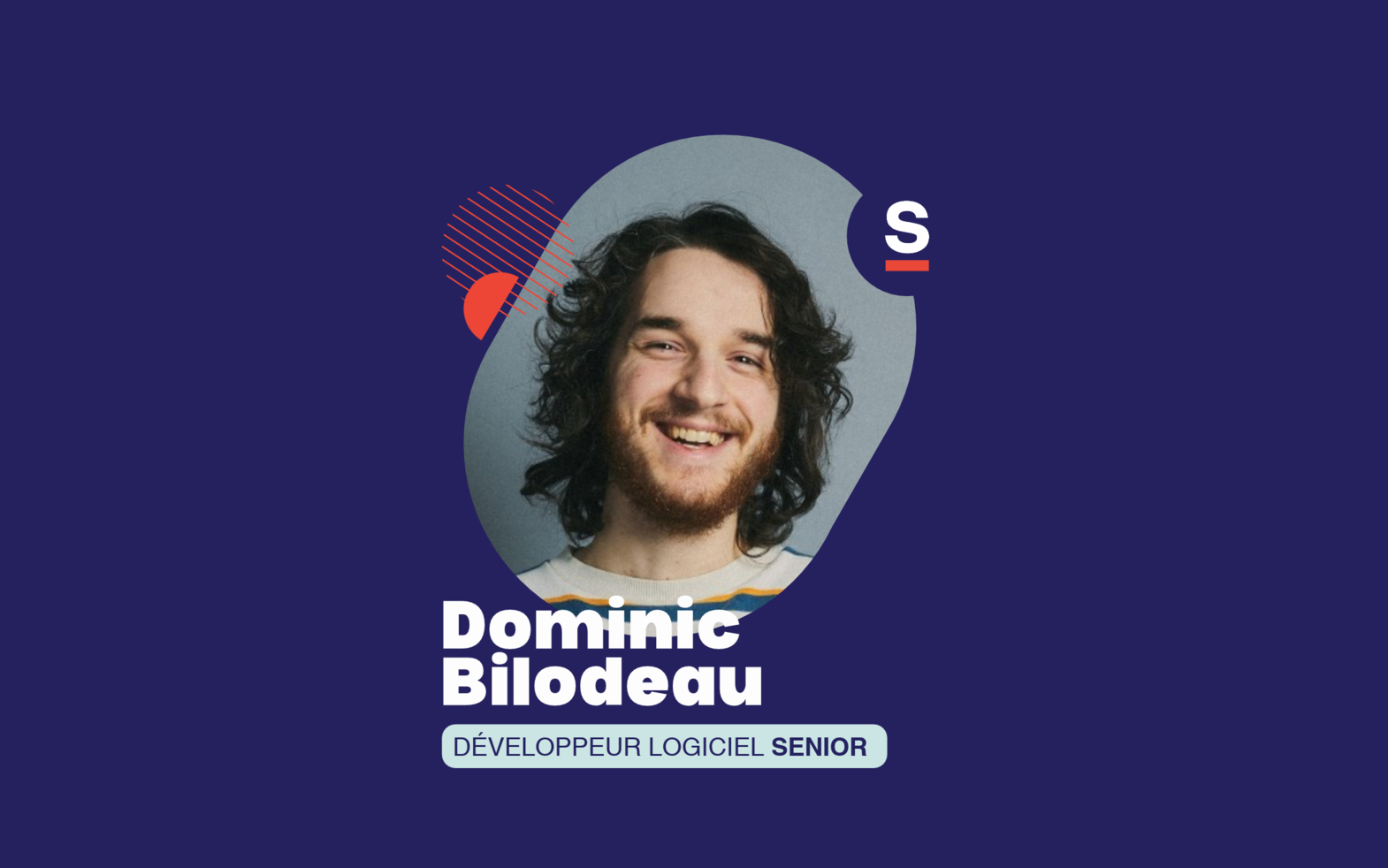
When understanding the day-to-day of the team and of our clients guides every line of code.
At Stamped, we believe that the best technology tools are worthless without top-caliber human experts to bring them to life. That’s why today we introduce Dominic Bilodeau, the person who builds, every day, the tools that let our CPAs move faster without ever sacrificing quality, notably through Lucy, our artificial intelligence agent.
1. Dominic, can you introduce yourself and tell us about your professional background?
With pleasure! I studied at Université Laval from 2013 to 2017, then dove straight into the world of development. My first job was as a data acquisition programmer analyst at BBA, where I learned to work with large amounts of raw information and make it usable. I then spent nearly two years at Robotiq as a computer vision developer, a field where you have to teach machines to interpret what they see. That gave me real discipline: nothing is obvious to a machine, so you have to explain everything clearly. In April 2020, I joined Stamped, and for more than six years now, I’ve been building the tools that run our platform.
2. Going from computer vision to accounting is a fairly unexpected turn. What drew you to Stamped?
It’s true that they seem far apart on paper, but at heart it’s the same challenge: turning raw data into something useful for a human. What drew me was the idea of building a product in a context where technology isn’t a side project, but the core of the business. And accounting turned out to be much more fascinating than I imagined. There’s logic, structure, and an enormous amount to improve when you look closely at the work. For a developer, it’s an extraordinary playground.
3. What exactly is your role at Stamped as Senior Software Developer?
My role rests on two sides that I always keep in balance. On one side, I develop the tools that support our operations team: the ones that make the work easier for the tax specialists, preparers, coordinators, reviewers and CPAs on every file. On the other, I look after our clients’ experience, so that our platform is simple and pleasant to use for SMB leaders. These two sides feed each other: a client who provides everything from the start means a team that works more efficiently. I’m also actively involved in the development of Lucy, our artificial intelligence agent.
4. You have an excellent knowledge of accounting for a developer. How does that change the way you design solutions for the team?
It changes absolutely everything! When you understand the operations team’s day-to-day, you know what happens when a file comes in with missing documents, when an opening balance doesn’t tie out, or when year-end is approaching and everyone is under pressure. I can really put myself in their shoes. Instead of asking myself “is this feature technically possible?”, I ask myself “is this really going to save them time on a Tuesday afternoon in March?”. That nuance makes all the difference between a tool people tolerate and a tool people adopt.
5. People say you take a very holistic approach when you design a solution. What does that mean concretely?
It means I don’t stop at the problem that’s reported to me. Being both a full-stack developer and involved in the product gives me a very holistic view of it. When a problem needs solving, I can quickly decide what kind of solution it calls for, whether at the backend, frontend, infrastructure, product, UI or UX level.
I also look at what surrounds the problem: who else is affected, which steps come before and after, and what the longer-term consequences will be. The goal is to find the solution that creates value for everyone, not just for the person who reported the problem. Sometimes that means solving a slightly different problem from the one that was asked, because that’s the real source of friction. It’s more demanding up front, but it avoids rebuilding the same thing three times.
6. You’re passionate about observing and listening to users. What does that bring you?
It’s probably the part of my job I love most. The best ideas almost never come from a planning meeting; they come from watching someone work, whether it’s a team member moving through a file or a client discovering the platform. I notice one click too many, a repetitive copy-paste, a piece of information you have to look up in three places, a question that keeps coming back. Often, these are small details nobody mentions because everyone has gotten used to them. And that’s where I realized that small changes can enormously improve quality of life day to day. Fifteen seconds saved a hundred times a day ends up adding up.
7. You also keep the client experience in mind. Why is that so important to you?
Because our clients are SMB leaders, and they’re not always comfortable with technology or with accounting. Their priority is their business, not learning a new tool. So my challenge is to make the platform so simple that they know right away what to do: clear steps, jargon-free language, and requests that explain why we need each piece of information. If a client has to wonder how to do something or feels lost, I’ve missed the mark. A successful tool is one an entrepreneur can use without training, between two meetings.
8. How does an easy client experience affect the team’s work?
Enormously. When a file has to be put on hold because an expected piece of information is missing, or because we can’t reach the client to collaborate, the team loses a lot of time and efficiency. You have to leave the file, move on to another one, then pick the thread back up later. That’s why I work to make sending all the information up front as simple and fast as possible, before the operations team even starts working. The more complete the collection is up front, the more the file moves forward without interruption, and the faster the client receives their deliverables. Everyone wins.
9. Tell us about your contribution to Lucy. How does she help the team, and what does she change about seasonality?
Lucy was born from the same principle as everything else: start from the team’s reality. I work with the people in operations to identify the tasks that take a lot of time without requiring professional judgment, then I work on handing them off to Lucy reliably. She takes care of the mechanical part, and the team keeps the judgment and the review. The result: we move much faster while maintaining quality.
It also changes seasonality. Historically, accounting has lived in seasonal bursts: everyone is swamped for a few weeks, then the pace drops off. With Lucy, the work progresses throughout the year, which smooths out those bursts, and the team can breathe easier.
10. How do you see artificial intelligence affecting the world of accounting, and what motivates you at Stamped?
I’m convinced AI will profoundly transform the world of accounting. Repetitive tasks will increasingly be handled by agents like Lucy, and professionals will be able to focus on analysis, advice and their relationships with their clients.
What makes me very happy to be at Stamped is that the company isn’t waiting for this transformation: it has already been using AI for several years and is at the forefront of the adoption curve. The company’s vision is stimulating, and it’s one of the reasons I stay engaged and motivated to push Stamped and its applications even further. To SMB leaders who are curious: come talk to us, we love showing what we’re building.