Meet Catherine Lecours, CPA, CGA
Our Senior Director of Assurance shares how more than fifteen years in accounting and technology help her shape Lucy, our AI agent, without ever losing sight of the human side of the profession.
 Catherine Lecours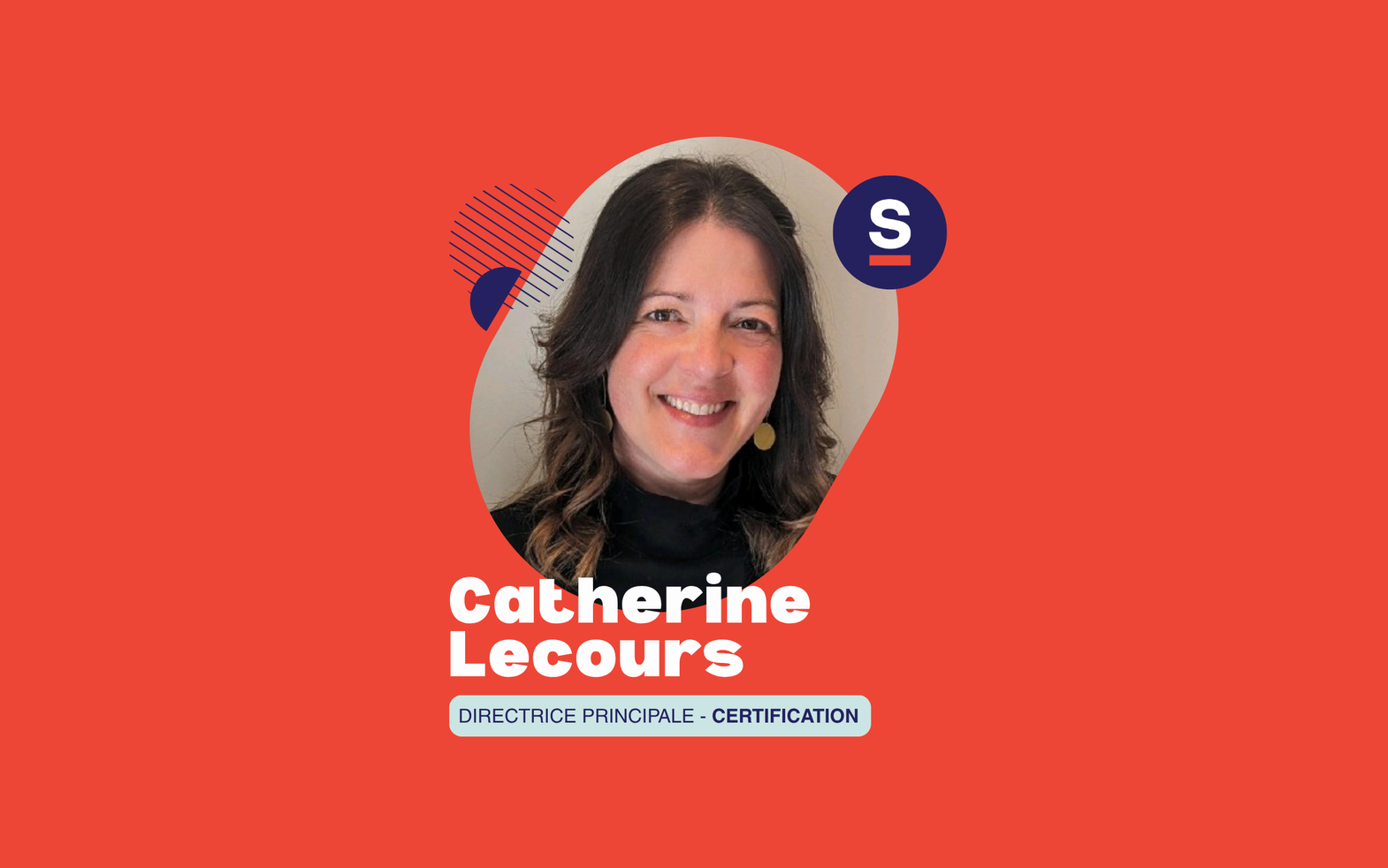
When accounting expertise meets the artificial intelligence transforming the CPA profession.
At Stamped, we believe that the best technology tools are worthless without top-caliber human experts to bring them to life. That’s why today we introduce Catherine Lecours, CPA, CGA, the person who helps shape Lucy, our artificial intelligence agent, every day, and who supports our clients with an approach that is as human as it is rigorous.
1. Catherine, can you introduce yourself and tell us about your professional background?
With pleasure! I completed a Bachelor of Commerce, majoring in finance, at Concordia University. After my bachelor’s, I went to the “school of life” and, after living abroad for two years, I decided to continue my studies to earn my CPA, CGA designation. I started my career at TNI The Network Inc., where I spent more than six years in charge of the accounting for more than 25 companies across Canada and the United States.
In 2015, I moved to Sydney, Australia, where I also worked at Grant Thornton as a senior accountant. When I returned to Canada, while continuing to work for Grant Thornton, I took on the role of cloud accounting services manager, a role that was only just beginning to exist in large firms at the time.
In 2021, I made a different kind of leap: I joined Intuit, the company behind QuickBooks, as business development manager for large firms. That position allowed me to collaborate with many accounting firms across the country. In August 2023, I joined Stamped as Senior Director, and this is where all of those experiences truly came together.
2. You’ve worked inside a large firm, then on the side of a software vendor like Intuit. What convinced you to make the leap to Stamped?
At Intuit, I had a privileged vantage point. I was meeting hundreds of accounting firms, small and large, and I could see very clearly who was adopting technology and who was still holding on to the old habits of paper and Excel spreadsheets. I saw with my own eyes the gap widening between traditional firms and those truly embracing the digital shift. My time in cloud accounting at Grant Thornton had already given me a taste of what cloud technology could do for a client, but at Intuit I realized there was still a missing piece: an accounting firm built from A to Z around that technology, with CPAs at the controls. When the opportunity at Stamped came along, it felt like the logical culmination of my entire career.
3. What exactly is your role at Stamped as Senior Director?
My role has two sides that feed each other. On one side, I oversee the production of financial statements and tax returns, as well as our bookkeeping and accounting support services. I make sure our clients receive human, personalized guidance throughout their accounting processes, even as we work to optimize those processes as much as possible through technology.
On the other, I’m actively involved in the development of our platform, particularly our artificial intelligence agent, Lucy. I work directly with our development team to make sure our tools, and Lucy especially, truly reflect the reality on the ground and the needs of professionals and entrepreneurs, a perspective I can bring thanks to more than fifteen years of experience in accounting and technology. This dual role lets me bridge practice, our clients’ needs and technology.
4. Tell us about your contribution to the development of Lucy, your AI agent. What does that involve concretely?
We’re currently training Lucy to take on the repetitive work in our engagements. My role is to make sure Lucy can bring genuine CPA judgment to the way she analyzes files.
I spend time with our team of developers explaining how an accountant reasons when faced with an ambiguous transaction, what questions they ask themselves and what signals lead us to dig deeper. Watching Lucy evolve, becoming more relevant and efficient with each engagement, is particularly rewarding.
5. How does Lucy concretely simplify your life and your team’s day to day?
Lucy lets us delegate a large share of the tasks needed to complete our engagements, which changes our day-to-day a great deal. Rather than devoting much of our time to documenting our analyses and conclusions, the team can focus more on the analysis itself and on the quality of our conclusions. Lucy takes on part of the execution work, while we bring our professional judgment where it’s truly needed.
In a context where the labour market is tightening and it’s becoming harder and harder to increase our capacity simply by adding people to the team, the time savings are considerable. They let us make better use of our expertise and devote more time to strategic, meaningful conversations with our clients, rather than to administrative or repetitive tasks.
For me, that’s where technology really makes sense: it lets us do what we already do more efficiently, while giving us more time for the part of our work that truly requires our judgment and our added value.
6. Coaching is one of your key skills. How does that translate into your role at Stamped?
Coaching is central to the way I work, with our team as much as with our clients.
With the team, I deeply believe in developing people rather than simply supervising tasks. I take the time to explain the why behind every decision, not just the how. With the arrival of artificial intelligence, this approach becomes even more important: as technology takes on some of the more repetitive tasks, my role is to further develop our team’s judgment, analytical ability and understanding. My goal is for everyone to understand not only how to do their work, but above all why we do it that way and how to exercise their own professional judgment.
Many entrepreneurs receive their financial statements without ever really having the chance to understand what their numbers are telling them or what they can draw from them for their business. My role is to make sure that after every conversation, they leave with a better understanding of their financial situation, but also with the tools and the confidence they need to make good business decisions.
7. Having seen the industry from inside a large firm and from the outside at a software vendor like Intuit, what truly sets Stamped apart from other accounting firms?
I think what truly sets Stamped apart is that we’re not simply trying to add technology to a traditional accounting model. Instead, we’re rethinking how accounting services can be delivered, starting from both CPA expertise and technology.
Our philosophy really is that technology should serve people: it should make us more efficient without losing the human side and the professional judgment that are at the heart of our profession. We’re both a CPA firm and a technology company, and those two realities don’t run in parallel: they grow together. That’s what allows us to rethink not only the tools we use, but also the way we support our clients.
8. What are the most common mistakes you see SMB leaders make with their accounting tools?
One of the mistakes I see most often is underestimating the time and effort it takes to keep the books up to date. Even though many SMBs have made the transition to cloud technologies, that doesn’t necessarily mean they know how to use them well.
We often see three situations: some use new tools with old ways of working, others place too much trust in the technology’s automations and suggestions, which can sometimes create a lot of problems in the books, and some simply end up setting their bookkeeping aside because they don’t have time to deal with it.
The problem is that errors and delays end up piling up. You’re then left with numbers that don’t necessarily reflect the reality of the business, and with surprises when it’s time to prepare the financial statements or the tax returns.
With the right tools, but above all with a good understanding of the technology and the right support, bookkeeping can become much simpler and more regular. And when the numbers are up to date and reliable, leaders can truly use them to understand what’s happening in their business and make better decisions, rather than simply looking at them once a year.
9. How do you see the CPA’s role evolving with the rise of artificial intelligence, like Lucy, in the coming years?
I think the CPA’s role will evolve toward more advice and mentorship, and much less toward repetitive tasks and data entry.
For experienced CPAs, I see a mentoring role with younger professionals, helping them develop their professional judgment, their critical thinking and their ability to go beyond the numbers.
With our clients, we’ll also be able to spend more time understanding their reality, advising them and having more strategic discussions to help them make better decisions.
And despite all this technology, I think it will be important to keep the human side of our profession. AI can do a lot for us, but it doesn’t replace the relationship of trust we build with our clients. Ideally, it should in fact give us more time for that relationship.
10. A final word for the SMB leaders still hesitating to change accounting firms?
Don’t wait for your accounting to become a problem before making a change. A good accounting firm should do more than produce your financial statements and tax returns. It should help you understand your numbers, advise you and support you in your decisions.
And above all, technology shouldn’t take away the human side. With the right tools and the right team, you can be more efficient while keeping a real relationship with your clients. If you feel your current firm no longer meets your needs, it’s worth seeing what’s being done elsewhere.